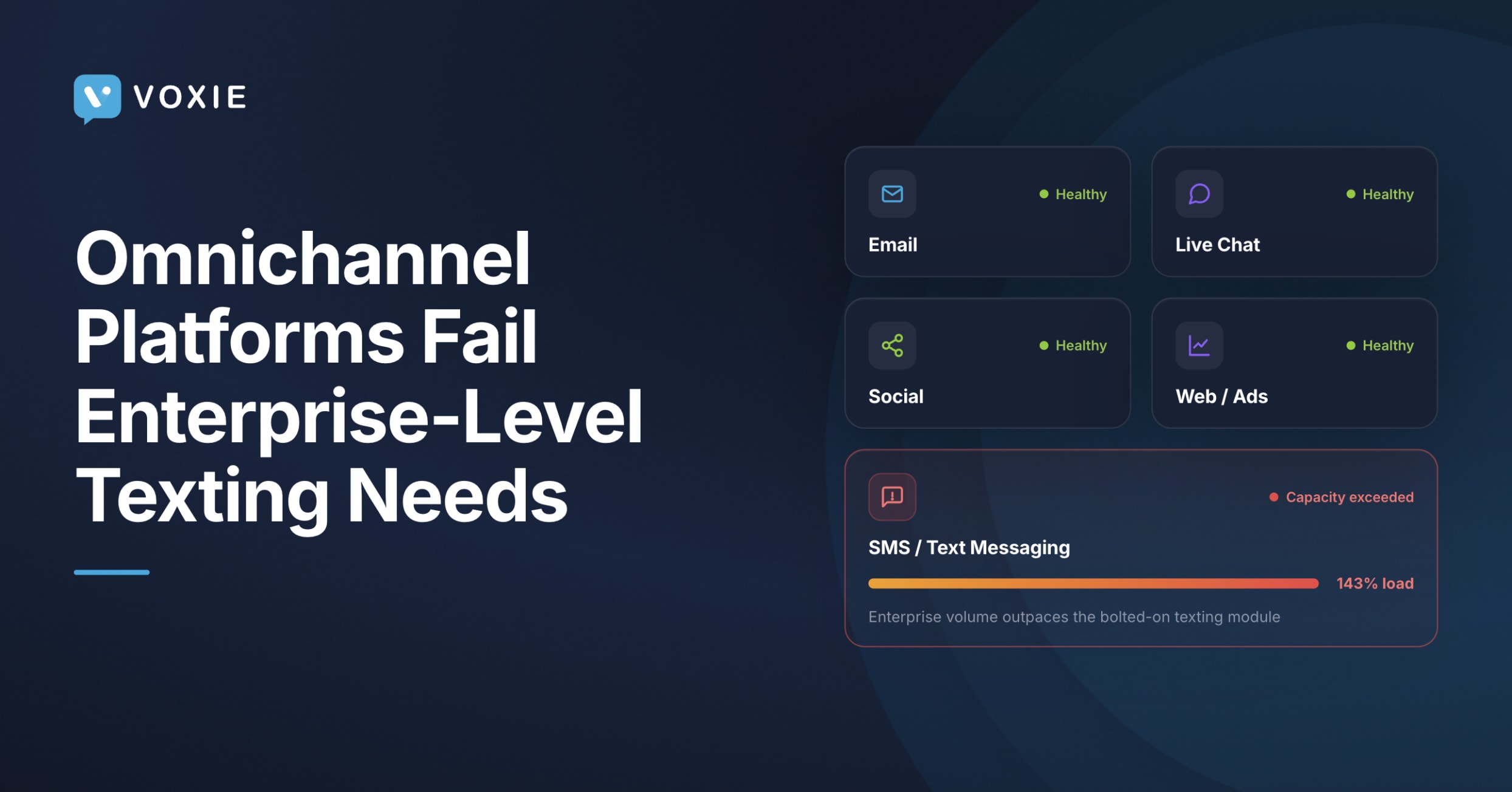
Omnichannel marketing platforms are designed to run every channel—email, push, in-app, social, and SMS—from one system. That breadth is the whole appeal, and for a business where texting is a minor channel, it's a reasonable trade.
Enterprise brands aren't that business. For an enterprise running texting across hundreds or thousands of locations, SMS carries real revenue and real regulatory weight, and the platforms managing it were never engineered for that load. The result: the channel keeps underperforming, and it's the one an enterprise can least afford to get wrong.
Enterprise franchise brands can’t afford to treat text like a supporting channel. It's where enrollment, scheduling, loyalty, win-backs, and daily conversations happen across every location. An operation at that scale needs an enterprise AI SMS platform built for the channel. Tools designed to do a little of everything keep coming up short on the one channel that has become load-bearing.
Omnichannel Platforms Broadcast, But Texting Done Right Is a Conversation
The issue starts with how omnichannel platforms are built, not their feature lists. The mismatch:
🗣️
How an all-in-one platform sees SMS: a destination
You build an audience, compose a message, and route it to the text channel the same way you would route it to email or push. The whole system is organized around the outbound send: schedule it, deliver it, count the opens.
👥
How customers actually use texting: as a conversation
Roughly 98% of texts are opened, the large majority within minutes. Unsurprisingly, engagement rates are also higher, with people often replying the way they reply to a friend.
The "blast" design suits email, where the relationship is largely one-directional and a campaign's job is finished the moment it lands in the inbox. Texting is the opposite: the value shows up in what happens after the customer writes back. When a platform's architecture has no real concept of the reply, every two-way capability has to be bolted on afterward.
Broader Direct Marketing Tools Fall Short the Moment a Customer Replies
An inbound message has nowhere natural to go, so replies pile up in an under-built inbox sorted by recency. Multiply that across hundreds of locations and it gets expensive:
- A new enrollment lead sits in the same undifferentiated queue as a routine schedule change and a complaint.
- The highest-value conversations get buried under operational noise.
- The revenue leak stays invisible, because no one can see the conversations they're missing.
A Platform Built for Texting Starts From the Reply
- Intelligent Inbox categorizes every conversation by topic and action state, so a franchisee opens the app to a command center—six enrollment-ready leads, four tour inquiries, eight schedule changes—with revenue opportunities already at the top.
- Conversational Intelligence reads tone and intent on inbound replies and routes them to the right person while the moment is still live, so a frustrated customer gets a fast recovery and a happy one gets asked for a referral.
Compliance Is a Liability That Now Sits With Marketing
Enterprise texting in the United States runs on machinery that omnichannel platforms sometimes hide inside a black box:
- A2P 10DLC brand and campaign registration
- Carrier trust scores that govern how many messages get through, and the throughput limits that come with them
- The CTIA Messaging Principles and Best Practices that carriers enforce
- TCPA rules carrying statutory damages from $500 per message up to $1,500 for willful violations
One non-compliant send to a few thousand contacts can cost more than a year of platform spend. That used to be legal's problem, but now it's marketing's.
The question a brand should ask isn't whether a platform "supports compliance," as most check that box. The question is who owns the carrier relationships, who monitors deliverability as a discipline, and who can tell you why your messages started getting filtered last Tuesday. When throughput throttles or a campaign registration stalls on an omnichannel platform, marketers are often left staring at a delivery number with no visibility into the carrier layer beneath it and no clear path to a fix.
An SMS-exclusive tool is much more likely to own that layer. For example, Voxie manages opt-outs and consent centrally across every location, so an opt-out on one number applies everywhere and a single franchisee's mistake doesn't become the brand's legal problem.
Here's what nobody selling an all-in-one will tell you: on their platform, your most regulated channel is somebody's side project. And when it breaks at enterprise scale, you're a support ticket behind their flagship products. For a channel carrying this much legal exposure, that's a risk I wouldn't accept.
Shane Welch VP of Customer Experience, Voxie
With Omnichannel Tools, SMS Competes With Other Channels on Product Roadmaps
Inside a company that sells email, push, web, in-app, and SMS as one bundle, every one of those channels competes for the same finite pool of engineering and product time each quarter.
For most omnichannel vendors, texting isn't the flagship or revenue center, meaning texting rarely wins that competition. However, a SaaS company whose entire product is texting has no other channel to divert attention toward. Every release cycle, every research dollar, and every new capability goes into that one thing. Give it a few years and the performance gap isn't a feature or two, but rather the whole product.
"One vendor" Concentrates Your Risk Rather Than Reducing It
Consolidation gets sold as prudence. Fewer contracts and fewer logins ultimately result in “one throat to choke.” However, this widely celebrated upside has its less-discussed vulnerabilities.
Putting your most time-sensitive and most heavily regulated channel inside a platform that treats it as ancillary concentrates your risk on the exact capability that the vendor is least focused on. When texting breaks on a bundled platform, your most urgent channel becomes a support ticket competing for attention behind products more widely used.
"But we need everything connected in one place"
The desire to centralize all data is arguably the strongest objection to utilizing multiple purpose-built tools within a marketing tech stack.
The fear is reasonable: if texting lives on a separate specialized platform, don't you end up with a fragmented stack, disconnected data, and no way to build a coherent customer journey across channels?
A unified customer experience doesn't actually require one platform, but rather to have your systems share data reliably and in real time. Manually managed and pressure-tested integrations solve this. When a customer buys at the register, earns loyalty points, or fills out a form, that data can move straight to the tools that need it. A texting platform that connects deeply to your POS, loyalty, and CRM does the same, plugging into your stack while staying the best tool for the one job it does.
Deep Integration Builds Better Journeys Than a Shallow All-in-One
The Voxie team handles all integrations so POS and loyalty platform data can trigger flows and personalize messaging. The text engagement data can feed into CRMs and other tools to further build out customer profiles. Doors that open through tactical integration include:
- Closed-loop attribution: A redeemed offer can be traced back to the exact subscriber who received the text, so texting stops being nebulous and becomes a revenue number you can defend.
- Behavior-triggered win-backs: A lapsing loyalty member can trigger an automated win-back the moment their behavior signals churn.
- Personalized, real-time content: A points-expiration reminder can populate with a member's real balance and their usual order, pulled live from the systems that hold that data.
That's real omnichannel: data moving between systems the moment it changes, not five logos on one invoice.
You Don't Have to Build the Connections Yourself
Architecture aside, the practical worry is who builds and maintains all those connections. Voxie takes that off the table directly by handling integrations on the customer's behalf. The Customer Success team configures the connections to your existing stack, builds the initial programs, and manages the technical lift.
For larger brands, Voxie can go a step further and work hand in hand with in-house engineers to equip a brand's own app interfaces with Voxie Intelligence capabilities. The governance and the intelligence live inside the branded experience the company already controls. The result is a connected stack alongside a platform purpose-built for texting.
What Separates an Enterprise AI SMS Platform From a Generic One: The Data
Nearly every platform now claims some form of artificial intelligence, which makes the claim itself a weak differentiator. What matters is the data the tool was trained on.
Predicting who will act on a specific text, at a specific location, in response to a specific offer, requires text-channel behavioral data in serious volume. A platform spread across five channels divides its AI’s bandwidth accordingly, meaning its intelligence will not be fully optimized on the latest behavioral trends.
Comparatively, Voxie Intelligence is built on more than a billion text messages analyzed across thousands of franchise locations. That foundation lets the Budget Optimizer forecast a campaign's likely return before a dollar is spent. It lets Intelligent Segmentation surface the highest-propensity contacts at each individual location. And it lets the Intelligent Inbox distinguish revenue-driving conversations from routine ones based on text-specific mannerisms.
A model trained across every channel may optimize for the average across all of them; one trained specifically on texting does not.
Omnichannel’s SMS Features Aim for Good Enough to Buy, Not Good Enough to Win
There is an uncomfortable reality in most platform evaluations: omnichannel SMS is usually good enough to pass procurement. It sends, it schedules, it checks the box on the RFP, and for a channel you barely use, good enough is exactly right.
Texting isn't that channel anymore. It's the channel customers read in real time and actually reply to. It carries your enrollment leads, your loyalty revenue, and the daily two-way conversations that drive local activity. On a channel this central to an enterprise-sized business, an adequate tool carries a cost that never appears as a line item. It appears instead as buried leads, filtered messages, compliance exposure, and generic campaigns that underperform.
Voxie—the only texting platform built for franchises—gives enterprise brands sophisticated capabilities, all bundled within an easy-to-use interface. Every innovation and product release is designed to help customers manage their text marketing and two-way communications with greater efficiency and measurable success.
To learn more, we encourage you to read case studies from customers like Sonic and the Learning Center or to schedule a demo with our team.

About the Author
Ali Spiric
Growth Marketing Manager at Voxie