Almost every text marketing platform is built on the same assumption: one business talking to its customers. Franchises are different; it is two parties, a brand and its operators, talking to the same audience from differing perspectives.
Corporate owns the brand, the compliance risk, and the strategy. Franchisees own the local relationships that turn a message into a sale.
A texting platform designed for a single business can serve one of those parties well, but rarely both at once. In franchise SMS marketing, that mismatch is where generic texting tools lead to:
- Operational inefficiencies
- Missed opportunities to capitalize on localized connections
- Higher risk of a compromised brand voice
What we mean by “cookie-cutter texting platform”
Most tools fall under what we consider to be _cookie-cutter texting platform_s. They may have highly sophisticated campaign building and operational capabilities, but they are built to serve a wide variety of business types. And, for many business models—ecommerce, B2B, and single-location businesses—this works.
However, franchises have more nuanced needs than most tools are designed to serve. This shows up in everything from the reporting structure to the billing routing to the user access levels. Built-in mechanisms that a franchise would rely upon to preserve the brand voice are deprioritized by generic texting platforms.
Why a franchise is two operations, not one
That division of labor goes deeper than it first looks. Neither party can do the other’s job: corporate cannot hold a personal conversation with a customer in a town it has never visited, and a franchisee cannot set brand-wide compliance rules or negotiate carrier registration.
For example, with a seasonal promotion, the brand sets the offer and the compliance rules. However, the franchisee in a college town knows to time it around move-in week, while the one near a retirement community would not. Strip out either contribution and the campaign underperforms.
💡
Good franchise texting depends on letting each party do its part without stepping on the other. Corporate sets strategy and guardrails; franchisees execute locally inside them. A platform built for a single, undivided business has no way to represent that division of labor, so it forces the network to choose which party it serves.
Where generic platforms fail franchises: the structure
A generic tool gives a franchise one flat container to run a layered organization, so the structure has to be recreated by hand, leading to:
- Contacts and data are not naturally segmented by location. Matching the tool to your organization means constant manual tagging to imitate a hierarchy it never understood. The tags tend to break the moment someone reorganizes a region or an owner buys another store.
- Permissions collapse into a flat admin-or-user switch. Novice franchisees versus experienced ones should not have the same editing and sending permissions inside the platform. Similarly, a franchisee with ten locations will appreciate different types of reporting than a single-location operator. With generic texting tools, people end up with far more access than their job needs, or far too little to do it.
- Billing runs through a single account. Corporate-funded and franchisee-funded sends get separated with spreadsheets and chargebacks after the fact. No one is ever quite sure the split is right, and reconciling it eats time every cycle.
What franchises need instead: an account structure that mirrors the franchise itself, with owners, regions, and locations built in, role-based permissions down to the individual user, and billing that routes to whoever actually pays.
The control versus local relevance problem
Faced with brand risk, many franchises prevent franchisees from texting at all and have Corporate write every outbound message. It stays on-brand, but it gives up localization and the results that come with it. Voxie's analysis of more than a billion franchise texts found that market-specific messaging roughly doubles engagement for quick-service restaurants. A national message from an unfamiliar number simply does not land the way one from the neighborhood store does.
Purpose-built franchise texting makes this a solved problem, in two ways:
- Franchisees localize, while the brand keeps quality control through AI approvals. Franchisees write and send their own local messages, and AI-based content review checks each one against brand and compliance rules before it goes out, so local voice never comes at the cost of oversight.
- Corporate localizes centrally. Franchise-specific software lets the brand localize on franchisees' behalf, sending national campaigns from each location's own local number with location-specific references built into approved templates.
The compliance and brand governance problem
Text marketing sits under the TCPA and a shifting patchwork of state laws, with statutory penalties that run from $500 to $1,500 per message. But that's not the only risk—franchisees can text with the wrong language or simply misrepresent the brand on the whole.
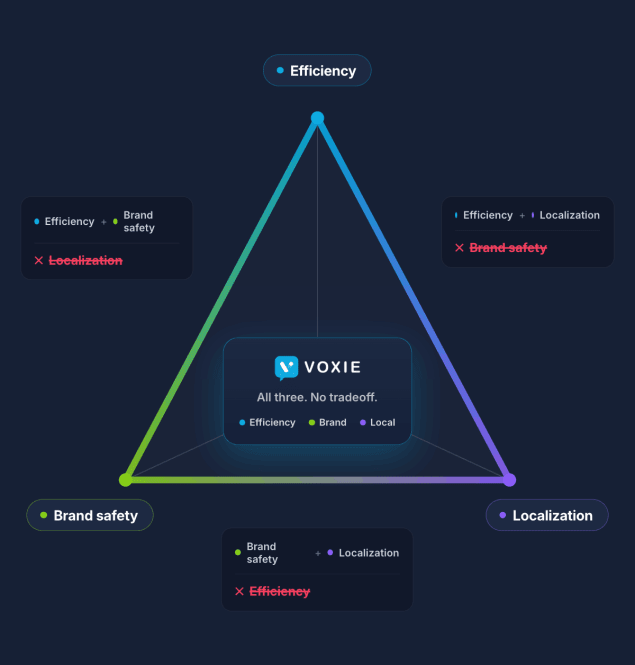
With a generic, "cookie cutter" platform, franchises must choose one of three routes, all with their limitations:
- Corporate handles all messaging, prohibiting franchisees from participating. Compliance stays tight, but the brand loses local voice and buries its franchisees' ability to drive revenue.
- All franchisee-written texts are manually approved by Corporate. Oversight is preserved, but the approval queue delays time-sensitive sends and consumes staff hours that scale with every new location.
- Franchisees text independently with no real-time oversight. The local voice returns, but so does the exposure: one non-compliant or off-brand message reaches customers who blame the brand, not the location.
Each route forces a franchise to sacrifice compliance, speed, or brand control. Purpose-built franchise texting removes the tradeoff by governing at the brand level rather than message by message:
- Platform AI enforces the brand rules before a send, not after. AI-based content review flags off-brand or non-compliant language in real time, giving franchisees the freedom to write without turning Corporate into a manual bottleneck.
- Provided templates can be semi-modified by trusted franchisees. The brand can arm franchisees with messaging proven to convert and, more importantly, dictate which elements are fixed vs. fluid.
- Compliance is managed centrally, not left to each franchisee. Consent and opt-outs are handled brand-wide, applied automatically across every number a customer might be reached from, so no single location can put the whole brand at legal risk.
- Corporate keeps a network-wide view. Every scheduled campaign is visible before it goes out, with the ability to edit or pull any send, so oversight is proactive rather than reactive cleanup.
The conversation visibility problem
Two-way conversations are where service franchise revenue is won: enrollment leads, appointment requests, tour inquiries, estimate follow-ups. While numerous texting tools offer text communication, they lack multi-level visibility so each inbox is in its own silo.
- Corporate has no visibility into franchisee conversations. It funds lead generation but cannot see which locations reply fast, which let leads sit, or how any given conversation was handled. This means they cannot step in, coach, or catch a problem before it costs a sale.
- Any consolidation of engagement metrics is highly manual. Conversation data lives location by location, so Corporate cannot easily compare response times, spot why one location converts at twice the rate of another, or turn what the top performers do into a playbook for everyone else.
Purpose-built franchise texting connects the two:
🌐
Shared visibility between Corporate and each inbox.
Corporate can see into local conversations without taking them over. The franchisee still owns the relationship while the brand keeps oversight and can identify individual training needs.
📊
Ecosystem-wide data aggregation.
Conversation and response data rolls up across locations, regions, and owner groups. Corporate can benchmark performance and turn the leaders' habits into playbooks.
Billing can be surprisingly inconvenient
In a franchise, it’s common for the brand to pay for any text sent by an individual franchisee is billed to that franchisee. And yet a cookie-cutter platform bills it all as one account. That leaves someone reconciling who owes what with spreadsheets and chargebacks after the fact.
Purpose-built franchise texting routes billing to match: the brand pays for the brand's texts, each franchisee pays for their own. No reconciliation, no chargebacks.
What to look for in a franchise texting platform
If you are evaluating platforms, the useful question is not which one has the longest feature list. It is whether the software is built around how a franchise actually operates: separate owners, regions, and locations acting as one brand. A few checks separate the two:
- Ask to see the account model. Are owners, regions, and locations first-class, or tags bolted on later?
- Confirm that permissions, sending, and billing all follow that same structure.
- Check that compliance and campaign oversight are centralized across every number, not left to each location.
- Look at whether you can measure conversations and performance by location, region, and owner group.
Voxie is the only texting platform built exclusively for franchises, and it is built to answer yes to all of them:
- Franchise hierarchy builds owners, regions, and locations into the account, so permissions, sending, and billing all follow your real structure.
- Brand Standards and AI content review enforce brand and compliance rules before a send, so franchisees keep a local voice without becoming a risk.
- Intelligent Inbox, Message Hub, and Conversational Intelligence surface revenue conversations, give Corporate shared visibility into every inbox, and resolve as much as 90% of routine questions automatically.
- Budget Optimizer and franchise-structured reporting target spend and break performance out by location, region, and owner group.
- Voxie Intelligence, trained on more than a billion franchise texts, and a dedicated success team handle setup, integrations, and rollout.
Nationwide franchise systems, including The Learning Experience and Sonic have already transitioned their text marketing operations to Voxie and seen results.
If your current platform is making your franchise work around its limits, it is worth seeing one built the other way around. Schedule a demo with Voxie, or read our Text Message Marketing Playbook for Franchises to go deeper.

About the Author
Ali Spiric
Growth Marketing Manager at Voxie