The localization and scale that make a franchise model powerful can also make it unwieldy. After all, a system has to speak with one brand voice across hundreds of independently owned locations, stay compliant when corporate and franchisees are both sending, and give every location a local feel without losing central oversight. The majority of generic text messaging software was not built for any of that.
It's for this reason that we compiled this list of text marketing software that is particularly well-equipped to meet the needs of franchise systems. Yes, as the only platform built solely for multi-location businesses, Voxie is the best. But there are reasons to consider others, whether you're seeking a budget-level solution or want one that caters to your specific industry.
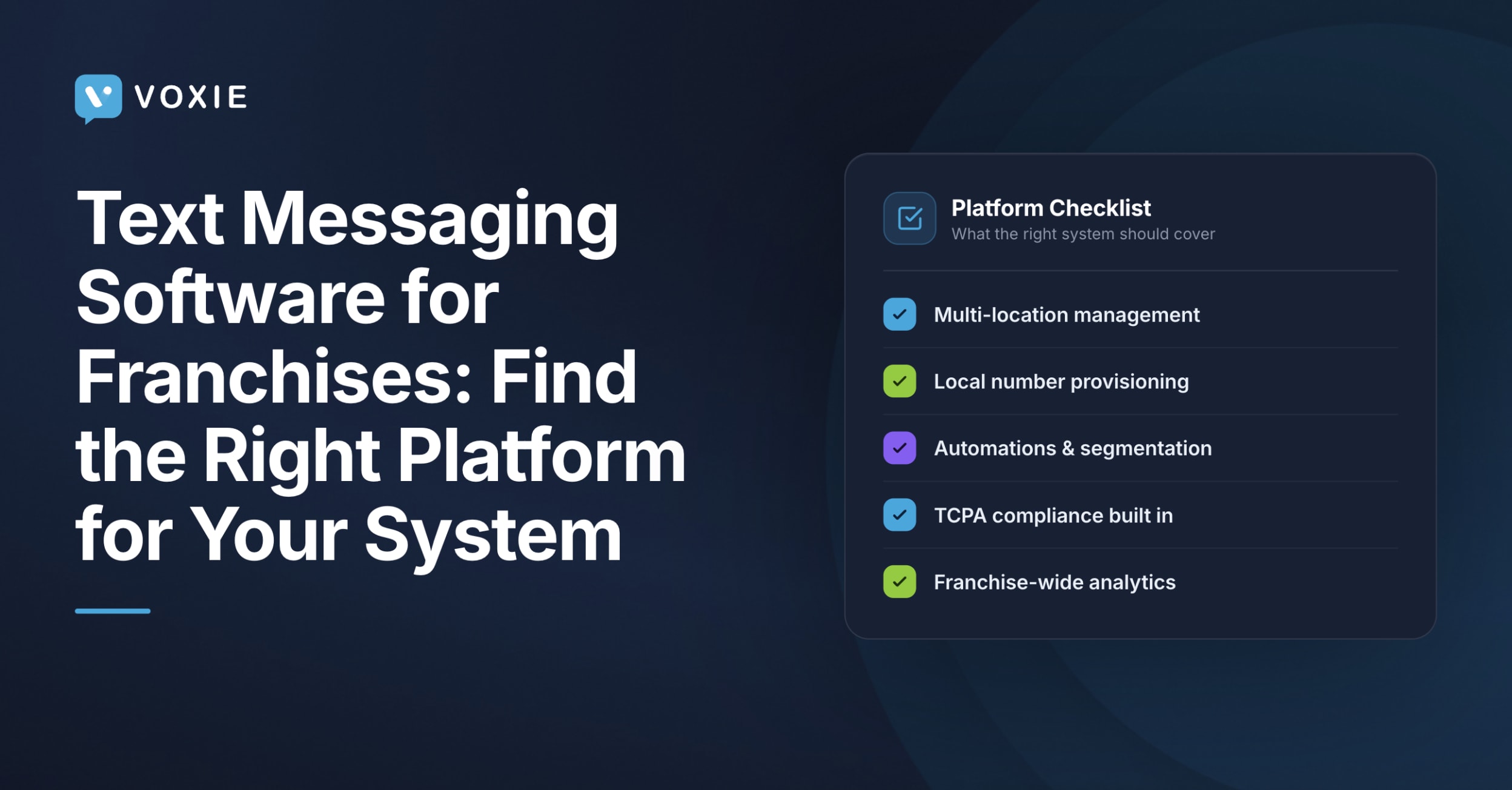
What franchises should prioritize in a text messaging tool
- Corporate, owner, and location as separate tiers. Can the tool model the organizational chart? A regional owner with twelve units should be able to see those twelve and nothing else. Simultaneously, corporate teams should have all-encompassing visibility into scheduled text campaigns and shared inboxes.
- A local number for every location. Can each store text from its own area code, so the message looks like the neighborhood location and not a corporate shortcode?
- National campaigns that localize automatically. When the brand team sends one campaign, does it deploy through each location's own number and personalize to local data? Voxie's own research suggests that localized messaging can more than double click-through rates.
- Location grouping for targeted sends. Can locations be bundled by ownership, region, or who is running a given promotion? This lets corporate target the right subset instead of all-or-nothing.
- Brand-level opt-out suppression. When a customer opts out at one location, are they suppressed across every location's number? Without it, one franchisee's mistake can become brand-wide legal exposure.
- Corporate-approved templates that can be adapted by permitted users. Can corporate share message templates? Moreover, can they dictate who can modify what within the platform? Having such settings allows the brand team to entrust editing to experienced franchisees while keeping tighter reins on newer members.
- Reporting that rolls up and drills down. Does the data aggregate for corporate and break out to a single location for the owner, in the same view?
- Billing that separates franchisor and franchisee. Can the platform route cost so the brand funds its own campaigns and each franchisee funds theirs?
See how Voxie answers the call by catering specifically to franchises.
Franchise-friendly text messaging software at a glance
| Platform | Best for | Main tradeoff | Type |
|---|---|---|---|
| Voxie | Franchise-wide governance: franchisors needing corporate control plus local execution | Custom-priced; overbuilt for a lone location | Text-first |
| Salesmsg | Sales-led texting for CRM-heavy teams in HubSpot or Salesforce | Built for reps, not franchise governance | Text-first |
| Project Broadcast | Local-owner campaigns for a single franchisee | Thin on corporate oversight | Text-first |
| Brevo | Marketing across email, text, and WhatsApp in one stack | A campaign channel, not a two-way inbox | Omnichannel |
| Attentive | Retail spanning physical stores and ecommerce | Channel at scale, not location governance | Omnichannel (SMS-led) |
| Canary | Hotel guest messaging tied to operations | Hotel-specific; not general texting | Workflow platform |
| HiJiffy | AI, multilingual guest communication for international hotels | Irrelevant outside hospitality | Workflow platform |
| Follow Up Boss | CRM-native texting for real estate brokerages | Not a standalone texting platform | Workflow platform |
| Smarter Contact | Real estate prospecting and follow-up | Pricier and more specialized than simple texting | Text-first |
| Clearstream | Church texting for Planning Center users | Church-specific | Text-first |
| Text In Church | Church guest follow-up across text, email, and calling | Too specialized for plain blasts | Omnichannel |
| Tatango | High-volume nonprofit fundraising | Too much for a small nonprofit | Text-first |
| GetThru | Nonprofit peer-to-peer outreach at scale | Not a broadcast marketing tool | Text-first |
| TextUs | Recruiting texting for staffing agencies in an ATS | Value depends on ATS fit | Text-first |
| Paradox | AI hiring automation for high-volume franchise roles | Recruiting automation, not text marketing | Workflow platform |
The best text messaging software for franchises
Voxie: best for franchise-wide text messaging governance
Every multi-location brand knows the tension: pull all texting into corporate and you get compliance and brand safety, but you lose the local speed and personalization that make text messaging work. Leave it to franchisees and you get local relevance, but also fragmentation, blind spots, and potentially TCPA violations.
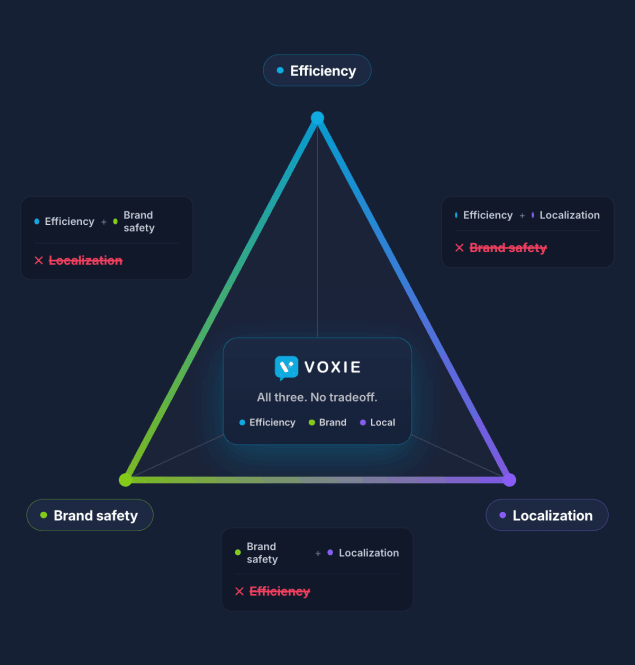
Voxie partnered with franchise thought leaders to understand these issues and engineer software solutions so brands don't have to compromise.
Corporate sets the guardrails, franchisees execute locally. Corporate owns the infrastructure, platform configuration, compliance rules, approved templates, and performance oversight. Meanwhile, franchisees respond to their own customers and personalize within those limits.
Corporate can lift its weakest locations without holding back their best. Because proven campaigns can be built once and deployed across the network, a brand's strongest playbook stops living only in its top franchisees' heads. For example, The Learning Experience, the childcare franchise, ran an automated, multi-step lead-nurture sequence across its 600 locations. Every center—not just the most proactive ones—followed up with inquiries the same way. In turn, locations saw a 28% increase in enrollment, 30% revenue growth, and a 2x lift in customer lifetime value.
Voxie pairs behavioral and localized targeting with system-wide efficiency. This manifests itself across a number of Voxie platform features, but arguably none more than in the Budget Optimizer. Here, users can see audience segments based on their potential and stage of the lifecycle, paired with the estimated ROI of a targeted campaign. More importantly, this software capability is available to individual franchisees so they can optimize their own text marketing budgets.
The intelligence is trained on franchise data, not generic SMS. Voxie's AI layer—Voxie Intelligence—is built on more than a billion text messages analyzed across thousands of franchise locations. Brands can merge this industry knowledge with their own brand guidelines to help the tool's AI flag weak texts and coach franchisees on how to improve them.
Voxie is deliberately narrow about who it serves: franchises and multi-location businesses with physical storefronts. It is particularly optimized for restaurants and service brands, with names like Sonic Drive-In, Edible Arrangements, and The Learning Experience on its roster.
The tradeoff: The full potential of this text messaging platform will only be felt if used by multiple locations. The cost and infrastructure could be "overbuilt" for franchisees managing their SMS independently and seeking software solely for their usage.
Voxie's pricing is scaled to number of locations, platform cost, and segments sent. We work directly with customers to land on the pricing model that fits how their system is built and how they run campaigns. That works in a brand's favor, but it also means there is no set package price to compare against the other tools here.
Another consideration? Voxie currently caters to US-based brands rather than international.
Learn more about all the ways Voxie supports Franchise texting efforts
Salesmsg: consider for sales-led texting inside the CRM
Salesmsg is built for the individual rep: an SMS-and-calling layer that lives inside HubSpot or Salesforce, so a salesperson can text, call, and log all of it against the contact record without leaving the CRM. It's a smart, affordable texting tool for service franchises that want efficiency in their one-to-one communications, but not necessarily the best platform for brands seeking comprehensive solutions.
CRM-native franchise teams will appreciate:
- Opt-outs write back to the CRM. When a contact opts out, that status posts to HubSpot as a property on the contact record, so consent stays with the rest of your customer data instead of in a separate texting tool. Most tools get this wrong.
- It can be activated from within the CRM. Texts fire from inside Workflows, conversations land on the contact timeline, and an org owner connects it once for everyone.
- It works as a two-way inbox, not a broadcast tool, so each reply goes to the rep who owns the contact.
On pricing, the advertised number hides what a franchise will actually pay. It starts around $25 a month for an entry tier of message credits and climbs with volume. On top of that, seats are billed per user, extra numbers carry a monthly fee, and 10DLC registration fees apply. Unused credits do not roll over, and a single long message can quietly burn two or three credits.
The tradeoff: Salesmsg is built to manage conversations, not to govern a network. There is no corporate-versus-franchisee permission model and no location roll-up out of the box. If a franchise wants to use texting to do more than nurture leads one-on-one, this is not the optimal platform.
Project Broadcast: best for the individual franchise owner
Where Voxie is built for the complexities of a franchise system, Project Broadcast can meet the needs of individual franchisees who handle texting independently. It lets that owner run local campaigns without an enterprise platform or a marketing team behind them. It is approachable, and it handles the basics well.
What stands out at this price point:
- Built-in landing pages: A local operator can stand up an opt-in page without buying a second tool, something most texting tools at this level skip.
- Keywords, tags, and a full spread of campaign types: broadcasts, drip, calendar, anniversary, countdown.
The thing to understand before buying is the credit model: how credits are priced, whether they roll over, and what media-rich messages cost, because that is where the real monthly number comes from.
The tradeoff: This texting tool is not built for corporate-level work with nuanced views and platform access levels. A brand that needs to govern hundreds of owners will outgrow this platform all too quickly.
Brevo: a viable platform for franchises wanting a "jack of all trades" platform
We've all heard the expression "jack of all trades, master of none." This applies to software just as much as it does people; a platform that divides its attention across multiple needs will find it hard to rival the individual capabilities of a more focused solution.
Still, there are upsides to an all-encompassing omnichannel platform, especially for franchises that deprioritize texting. For such brands, Brevo is a worthy choice. It started in email and grew into a broader engagement suite, and texting fits the same pattern. You send it from inside an automation workflow, alongside the email and the WhatsApp message, instead of running it as a two-way conversation hub.
There is no standalone pricing plan; you buy prepaid credits in packs, and they do not expire. The per-message price varies by recipient country and message length, and some countries require sender-ID registration. For a brand that thinks in lifecycle journeys across channels, that is a clean fit and a single place to manage consent across email and text together.
Another upside? Brevo is equipped to handle multi-national franchises. Oliviers & Co used Brevo to centralize their data for improved segmentation, leading to 40% more actionable leads in France while simultaneously recovering 10% more contacts in the USA.
The tradeoff: Brevo is built for outbound omnichannel campaigns, not the text-first, reply-and-route, location-by-location inbox work that defines franchise texting. If two-way local conversation is the point, Brevo is aimed elsewhere.
Attentive: consider for retail spanning physical stores and ecommerce
Attentive belongs in this guide for a specific kind of franchise-adjacent operator: the retailer whose customer shops both online and in the store, and whom the brand should recognize as one person across both.
Its DNA explains the fit. Attentive was built on an SMS and mobile-identity foundation, and it has since grown into a full omnichannel platform spanning email, RCS, and push. What we like:
- The two-tap sign-up: This method converts far better than a form that asks someone to type a phone number. A shopper taps a button, their messaging app opens with a pre-filled text, and one more tap subscribes them.
- The same sign-up tools run both in-store and online: The number you collect at the register and the cart someone abandons at midnight can land on the same thread, and browse, cart, and post-purchase messages all trigger off real behavior.
Two honest cautions, because this is where buyers get surprised:
- Attentive's center of gravity is direct-to-consumer ecommerce, much of it on Shopify. The in-store bridge is real, but the platform's heart is online retail.
- You will need to be scrutinizing with its reported attributions: a 30-day click window by default, which can credit Attentive for a sale that a later, unrelated visit actually drove. Agencies also flag data-sync friction when sign-up data hands off to a separate email platform. Read its revenue numbers with that window in mind.
The tradeoff: Attentive is a channel built to scale one brand's customer list, not to govern a network of independently owned locations. A franchised retail chain still has the location-control problem Attentive does not solve, and for that the franchise-platform conversation at the top of this guide applies. The corporate-owned retailer with a website and stores is who Attentive fits.
Text messaging software for hotel franchises
First and foremost, hotels need text messaging tied to the guest's stay, pre-arrival, check-in, in-room request, checkout, and a chatbot that can answer the 11 p.m. question about the pool without waking the front desk. Voxie and other texting platforms can certainly execute such flows, but hospitality-specific tools are pre-configured to meet hotel franchises' unique needs and sometimes have broader multi-language capabilities.
Canary: the full-stack guest-experience pick
Canary treats messaging as one piece of a larger guest-management system rather than the product itself. On its platform, guest messaging comes bundled with mobile check-in, payments, upsells, and tipping. All of it is wired into the property's PMS, so a message attaches to a real reservation rather than just a phone number.
What defines it:
- The AI handles a large share of guest conversations—reported to be at least 80%—and routes the rest.
- It doesn't require guests to download an app to respond to messages, which hotels report lifts usage several times over.
- A Holiday Inn Express & Suites near Orlando's SeaWorld credits Canary's AI guest tools with exactly that combination of automated messaging and recovered staff time.
The tradeoff: this is hotel software, not a texting tool. A hotel franchise that only wants simple outbound alerts would be paying for a large guest-experience platform it will barely touch.
HiJiffy: the AI guest-communication pick
HiJiffy is a Guest Communications Hub built first around AI conversation. The proprietary engine handles guest messaging across web chat, social, WhatsApp, and OTAs in more than 130 languages. That range is why it has been adopted across European and international hotel groups, more than 2,100 hotels in 50-plus countries.
Such software more than pays for itself. Leonardo Hotels' deployment of HiJiffy—spanning 213 properties—reported a 93% automation rate. Roughly 261,000 of 281,000 guest conversations were handled without a human agent.
The tradeoff: The automation rate is strong but not absolute, and reviewers note the WhatsApp-and-PMS setup can take real effort to get right. Plus, it doesn't offer sophisticated marketing blast capabilities.
The pick between them: Canary for full-stack US guest operations with messaging bundled into check-in and payments; HiJiffy when multilingual AI across the booking journey is the priority.
Text messaging platforms for real estate franchises
Real estate texting falls into two tool types. One lives inside the CRM that holds your leads while the other runs as a standalone outbound prospecting engine. Brokerages rarely need both.
Follow Up Boss: the CRM-native pick
Follow Up Boss is a real estate CRM first, so text conversations live on the lead record.
Group texting is the feature that shows the real-estate focus, a feature Follow Up Boss is proud to offer natively. An agent can hold both halves of a couple—plus the lender and the transaction coordinator—in one thread, with the full history logged automatically against the contact. Speed-to-lead texts the moment a lead lands, drip nurture, and ringless voicemail round out the set. Across all of it, the communication stays tied to the lead and the agent instead of scattered across personal phones.
That coordination holds up at scale. The Ashton Real Estate Group, a 180-agent RE/MAX team, attributes its growth—partly to running follow-up through Follow Up Boss across the whole roster—to roughly $1B in annual sales.
Pricing starts around $69 per user per month. But calling and two-way texting are a paid add-on at that tier, bundled in only on the Pro and Platform plans. This is CRM pricing, not texting pricing.
The tradeoff: it is a CRM with texting capabilities, not a text-focused platform. So manage your expectations.
Smarter Contact: the prospecting and follow-up pick
Smarter Contact starts from the opposite assumption: that the job is outreach, and the CRM is secondary or already handled. It is a text-first platform built around real estate prospecting and follow-up.
Its deliverability engine staggers the sends and watches carrier filtering, so a team texting hundreds of leads about a new listing does not get flagged as spam. Also, it bundles the outbound tools real estate investors lean on: a power dialer, ringless voicemail, and built-in skip tracing.
Smarter Contact integrates with CRMs like Salesforce and Podio rather than trying to replace them, which tells you where it sits in the stack.
The regular pricing tiers run roughly $199 (Starter), $399 (Pro), and $499 (Elite) per month, billed quarterly or yearly rather than month to month, with about $0.02 to $0.03 per text on top. Higher-volume committed-use plans that bundle texts start around $799 a month.
The tradeoff: This tool is specialized and not cheap. For casual local texting, or any business outside real estate that just needs reminders, it offers more than would be necessary.
The pick between them: Follow Up Boss when CRM-native texting matters most; Smarter Contact when prospecting volume and deliverability are the priority.
Church franchise text messaging platforms
Multi-campus churches operate like franchises: central brand, local campuses, volunteers, recurring events, and a steady flow of first-time guests to convert into regulars. Both church text messaging platforms here run on Planning Center but they diverge on what they are optimized to do with it.
Clearstream: the Planning Center-connected pick
Clearstream's defining strength is the depth of its Planning Center integration. For example, when a visitor texts a keyword on Sunday morning, Clearstream creates a new profile in Planning Center and drops them into a follow-up workflow; for a multi-campus church, it then routes the reply by Campus ID. If everyone texts the same keyword, each person gets a campus-specific reply.
Subaccounts give each campus or ministry its own number and inbox, which is the church equivalent of a franchise hierarchy. Plans start around $29 a month, and church plants under a year old can use it free.
The tradeoff: the credit model draws consistent criticism, with reviewers finding it confusing and noting that media-rich messages cost more than expected.
Text In Church: the guest-follow-up pick
Text In Church shares the Planning Center sync, but it is built around relationships rather than mass sends. Its signature feature shows the difference: Plan A Visit. A digital connect card turns a website visitor into a known guest before they arrive, then kicks off an automated welcome sequence.
One church reported that 67% of guest families running through that flow took a next step toward becoming regular attenders. The whole platform leans toward consistent, automated guest follow-up so the work does not depend on a staffer remembering to send the text.
The tradeoff: The focus on building relationships via text is overkill for a church that only wants to blast an announcement.
The pick between them: Clearstream for the tightest Planning Center integration and campus routing; Text In Church when the first-time-guest journey is what you most want to systematize.
Text messaging platforms for nonprofit franchises
For a nonprofit franchise, the choice of texting platform comes down to a single question: are you trying to raise money at volume, or move people to act? Broadcasting a fundraising appeal to a huge list and running thousands of individual organizing conversations are not one and the same. Tatango and GetThru are built for opposite ends of that divide.
Tatango: the high-volume fundraising pick
Tatango is built for scale and urgency: dedicated short codes, high-throughput sending measured in millions of messages per hour, and a feature set pointed squarely at donor campaigns and text-to-give. It also integrates with the fundraising stack nonprofits already run.
The short-code orientation is the strategic choice, strong for brand recognition and deliverability on big, time-sensitive sends. Pricing reflects the scale: short-code plans commonly run from around $500 a month for a random code to about $1,000 for a vanity code. Eligible 501(c)(3)s can get that leasing cost cut by roughly 60 percent.
The tradeoff: Tatango isn't "the budget option" and may be too expensive for a small nonprofit that only needs occasional reminders. It earns its cost at volume, and not much below it.
GetThru: the peer-to-peer mobilization pick
GetThru solves the other problem entirely. Its core products—ThruText and ThruTalk—are built for peer-to-peer texting and calling: many staffers or volunteers send individualized, one-to-one messages instead of one broadcast. Each texter can move north of 200 messages per minute. It comes out of progressive political organizing, and that heritage shows.
This platform offers two-way integrations with VAN, EveryAction, and ActionKit, plus features built for volunteer-driven campaigns like event recruitment, surveys, advocacy, and get-out-the-vote.
The tradeoff: it is not a broadcast marketing tool, and a nonprofit that only wants automated donor drips will find it pointed the wrong way.
The pick between them: Tatango for high-volume fundraising broadcasts; GetThru for volunteer-powered, one-to-one conversation at scale.
Text messaging tools for staffing and recruiting franchises
In high-volume hiring, response speed decides who you reach before a competitor does, so staffing franchises and recruiting-heavy brands depend on it. The two tools here approach it differently. One is a texting layer for recruiters and the other is a full hiring-automation engine.
TextUs: the recruiter texting layer
TextUs is the established recruiter-texting platform, and its value runs almost entirely through the applicant tracking system. It plugs natively into Bullhorn, Greenhouse, JobDiva, Workday, and others. The Chrome extension is the detail that makes it work.
A recruiter texts a candidate from inside the applicant tracking system (ATS), and the conversation logs back to the candidate record automatically. Shared inboxes let a team coordinate so a hot candidate never sits unanswered, and campaigns and sequences handle outreach at scale.
Pricing starts at $499 a month base subscription, which signals its intended buyer: recruiting teams rather than a lone recruiter after a cheap number.
The tradeoff: the value of this texting platform rises and falls with ATS fit. If your applicant tracking system is on its integration list, it works well. If not, much of the advantage goes away.
Paradox: the AI hiring-automation pick
Paradox is a conversational AI hiring assistant that runs the high-volume recruiting motion end to end: conversational apply, screening, self-scheduling, reminders, rescheduling, and onboarding. Text is just one of the several managed communication options.
As of October 2025, Paradox is part of Workday, sold as the Workday Paradox Candidate Experience Agent. It was built for exactly the franchise hiring problem: frontline, high-volume roles in restaurants, retail, and healthcare, where time-to-hire is everything. The system reportedly schedules tens of millions of interviews a year. For instance, Flynn Group—operating seven brands across hundreds of locations—reports automating roughly 90% of its hiring process with Paradox.
The tradeoff: this is the heaviest, most enterprise option on the list, and you're buying into a real implementation and a product that just changed hands, not a quick texting add-on.
The pick between the two texting platforms: TextUs to give recruiters fast, ATS-logged texting; Paradox when the problem is automating the whole apply-screen-schedule pipeline at volume.
Franchises need texting tools ready for the challenges of compliance
TCPA compliance matters to brands regardless of their business model, but franchises naturally have a greater risk than the typical business.
A customer may interact with several locations, and corporate may run national campaigns while franchisees run local ones. Depending on the franchise relationship, one location's mistake can create exposure that reaches the brand. The TCPA's statutory damages start at $500 per message and rise to $1,500 for willful violations, which compounds fast across a list. Opt-out rules have continued to tighten, too.
The practical safeguards a franchise should ask any SMS platform vendor about:
Opt-outs across locations. How are opt-ins and opt-outs documented, and does an opt-out at one location suppress the customer across every location's number?
Automated flagging of problems. What happens if a franchisee submits an uncompliant text to the system? Ideally, the platform would both block them from sending it and provide actionable feedback.
Sending hours. Does the platform respect local sending windows across time zones?
Registration and suppression. How are A2P 10DLC registration and suppression lists handled?
Corporate visibility. Can the brand see and control franchisee-level campaigns?
This is where built-for-franchise platforms pull ahead of general texting tools: the controls (and backup controls) are at the forefront of the product's design.
Level-up your franchise’s texting with targeted software and solutions
Franchise texting comes down to two decisions, not one: pick the platform built for how your system actually runs, then put the guardrails in place that keep one location's mistake from becoming a brand-wide problem. Get both right, and texting stops being a liability you manage and becomes the channel that scales your best franchisee's playbook to every single storefront.
Frequently asked questions about franchise text messaging software
What is the best text messaging software for franchises?
There is no single best text messaging software for franchises, because the right platform depends on the workflow it has to fit. For brand-wide governance across many locations, a franchise-native platform like Voxie is the category. For sales-led franchises, a CRM-connected tool like Salesmsg fits better; for hotels, real estate, churches, nonprofits, or staffing, the specialized vertical tool usually wins. Match the platform to who sends the message and where the reply needs to go.
How much does franchise SMS software cost?
Pricing ranges widely by model. Local-owner tools like Project Broadcast and church platforms like Clearstream start around $29 a month on credit-based plans. Per-user CRM and recruiting tools run higher: Follow Up Boss from about $69 per user per month, TextUs from a $499 a month base. Nonprofit short-code platforms like Tatango commonly run $500 to $1,000 a month. Franchise-native and enterprise platforms such as Voxie and Paradox use custom pricing scaled to locations, volume, and features. Watch for add-ons that inflate the headline price: per-seat fees, extra numbers, non-rolling credits, and A2P 10DLC registration charges.
Do franchisees need their own local phone numbers?
For most franchises, yes. A text from a recognizable local number gets better response than one from a corporate shortcode, because it reads like the neighborhood store. The better franchise text messaging platforms let each location text from its own local number while corporate keeps centralized oversight. That balance is one of the criteria that separates a true franchise platform from a general texting app.
Is text message marketing TCPA-compliant for multi-location brands?
It can be, but franchises carry more compliance risk than single-location businesses. A customer may interact with several locations, corporate may run national campaigns while franchisees run local ones, and one location's mistake can create brand-level exposure. The safeguards that matter are brand-level opt-out suppression across every location's number, documented consent, A2P 10DLC registration, and corporate visibility into local campaigns. None of this is legal advice; confirm specifics with your own counsel.

About the Author
Ali Spiric
Growth Marketing Manager at Voxie