The larger your subscriber list, the more each text message matters. After all, every text you send has a price tag attached; strong messages earn it back many times over, and weak ones just stack the bill higher across your entire list.
Most marketing texts underperform for the same few reasons:
- They run long
- They bury the offer
- They lack deadlines or innate urgency
- They lean on emojis
- They land at the wrong time
Each of those habits costs you twice: customers who don't act, and a bigger per-message bill. To see these principles in practice:
Before:
Hello valued customer! We are excited to announce that our store is having a wonderful sale event this weekend with many great deals available on a wide variety of products, so please come visit us soon to take advantage!
After:
[Brand]: Weekend sale 🎉 25% off everything, today + tomorrow only. Shop now: [link]. Reply STOP to opt out.
Same intent, but one of them merely gets read, while the other drives sales.
Voxie’s Cheat Sheet to Effective Text Messages
| What works | Why |
|---|---|
| Pick one goal per message | A text that asks for three things gets none of them. |
| Put your brand name first | Unknown senders get opted out. |
| Lead with the offer | The first line decides whether they keep reading. |
| Keep it to 160-300 characters | Shorter messages get read. Longer ones cost more to send. |
| Limit emojis to one | A single emoji can triple the cost of a message. Details below. |
| Give a real deadline | "Today only" drives action. No deadline, no urgency. |
| Send 9 a.m. to 7 p.m. local time | Off-hours texts read as intrusive. |
| Text 2 to 4 times a month | Quieter and they forget you. Louder and they opt out. |
| Make opting out easy | It's a legal requirement, and clean lists perform better. |
Start with the one thing you want them to do
Every text should have a single, obvious goal: redeem an offer, book an appointment, reply with a keyword, visit a link. If you're trying to do three things in one message, you'll do none of them. Decide the action first, then write backward from it.
Lead with the value, not the warm-up
People decide whether to keep reading in about two seconds, so front-load the good part.
- Weak: "Hi! We hope you're having a great week. We wanted to let you know that we're running a promotion..."
- Strong: "20% off your next order today only 🎉 Use code SAVE20:"
The pleasantries feel polite, but on SMS they're just clutter between your customer and the reason you texted them.
Keep it short and scannable
Aim for one clear idea per message. We recommend keeping messages concise, in the 160 to 300 character range. Not because longer messages won't send, but because shorter ones get read. If you need more room, put the most important words first so the message still works in the preview. Keep in mind that any message exceeding roughly 900 characters may run into deliverability issues, and it will be more costly to send.
Always identify yourself
Open with your brand name so there's no "who is this?" moment. A customer who can't place who's texting them is a customer reaching for the opt-out. "Voxie:" or "[Brand] here:" at the start does the job.
Make the call-to-action impossible to miss
Tell them exactly what to do and how. "Reply YES to claim," "Tap to shop," "Show this text at checkout." Vague CTAs like "learn more" leave people guessing. Specific verbs win.
Create a reason to act now
SMS rewards urgency because it's an immediate channel. A deadline ("today only," "ends at midnight," "first 50 customers") gives people a reason not to swipe away and forget. Use this honestly. Fake urgency erodes trust fast.
Personalize when you can
A name, a past purchase, a location, a birthday. Even small touches make a message feel like it was meant for one person instead of blasted to ten thousand. "Happy birthday, Sam, here's a treat 🎁" outperforms a generic greeting nearly every time.
Use emojis with a light hand
A well-placed emoji adds warmth and draws the eye. A message that looks like a ransom note of party hats does the opposite. One or two, tops.
Mind the timing
A text at 7 a.m. or 11 p.m. reads as intrusive no matter how good the offer is. We recommend sending between 9:00 a.m. and 7:00 p.m. in the customer's time zone to stay within safe sending hours. Within that window, late morning and early evening tend to perform best.
Find the right frequency
How often you text matters as much as what you say. Go too quiet and contacts forget who you are, which drives up opt-outs the next time you do reach out. Send too often and you become noise. We recommend at least one message a month as the floor to keep a contact warm and engaged, with two to four messages a month being the true sweet spot. That cadence keeps your brand top of mind without wearing out your welcome.
Make opting out effortless
Every message should make it easy to leave (typically "Reply STOP to unsubscribe"). It's good manners, it's a legal requirement, and a clean, respected list outperforms a big, annoyed one every time.
More examples, good and bad
Here's how these principles play out across a few real-world offers.
Arby's — BOGO fries
- ❌ "Hello from Arby's! We wanted to share that for a limited time we are offering a special deal on our curly fries where you can buy one order and receive a second one at no additional cost, so stop by today!"
- ✅ "Arby's: BOGO curly fries 🍟 Buy one, get one free, today only. Show this text at the counter. Reply STOP to opt out."
Why it works: The good version names the brand, leads with the offer, sets a clear deadline, and tells the customer exactly what to do.
British Swim School — $50 off your first month
- ❌ "Hi there! British Swim School here because we have an exciting opportunity for new families who are interested in swim lessons to save some money when they decide to enroll with us."
- ✅ "British Swim School here: Sign up this week and get $50 off your first month 🏊 Enroll now: [link]. Reply STOP to opt out."
Why it works: The weak version buries the offer behind a warm-up. The strong one puts the savings and the deadline right where the eye lands.
Heights Wellness — first month free
- ❌ "Greetings! We are running a HUGE membership promotion this month and would love for you to consider becoming a member at Heights Wellness to take advantage of our great offer."
- ✅ "Heights Wellness: Join this month and your first month is free 💪 Limited time. Claim it here: [link]. Reply STOP to opt out."
Why it works: Same offer, far more urgency. The customer knows the brand, the deal, the deadline, and the next step in one glance.
The Little Gym — Parents Night Out
- ❌ "Hello parents! The Little Gym is excited to let you know that we will be hosting one of our popular Parents Night Out events this coming Saturday evening, which is a great chance for your little ones to have some fun while you enjoy a night to yourselves."
- ✅ "The Little Gym: Parents Night Out this Sat 5-8pm, just $50 🎉 Kids must be bathroom independent. Spots filling fast, book now: [link]. Reply STOP to opt out."
Why it works: The good version packs the key details (date, time, price, requirement) into a scannable message and uses real scarcity to drive the booking.
The quick checklist
Before you hit send, run through these:
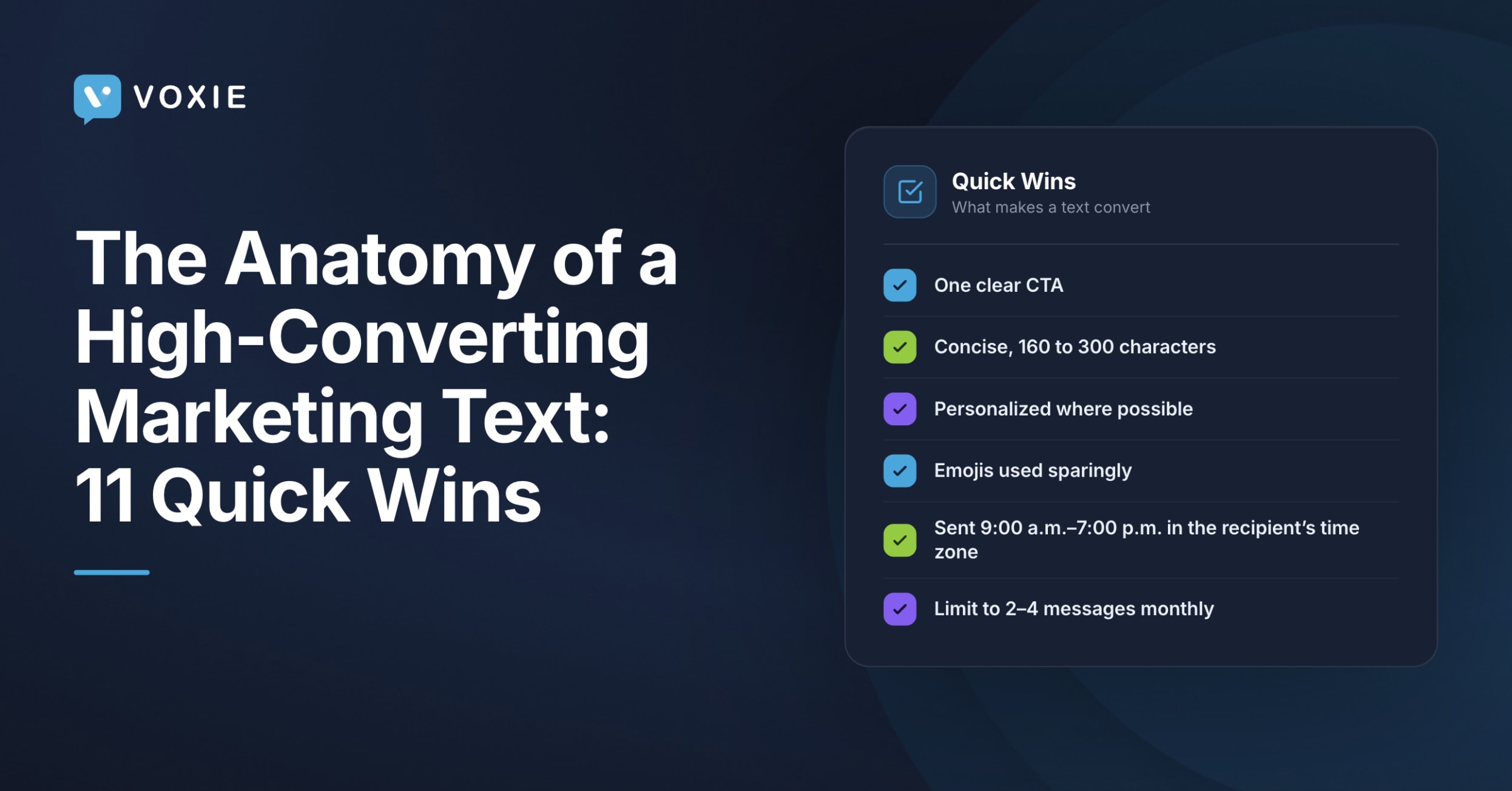
- One clear goal, one clear CTA, and a reason to act now
- Brand name and value up front
- Concise, 160 to 300 characters (and never over ~500)
- Personalized where possible
- Emojis used sparingly
- Sent between 9:00 a.m. and 7:00 p.m. in the recipient's time zone
- Part of a healthy cadence (2 to 4 messages a month)
- Easy opt-out included
Nail these and you'll be writing texts people actually look forward to, which on a channel this personal is the whole game.

About the Author
Shane Welch
VP of Customer Experience at Voxie